Every object has a story, and a question that pops up frequently for libraries with physical artifact collections is, “How do we share these valuable historical stories with folks who can’t visit us in person?”
At The Ohio State University Health Sciences Library (HSL), we are proud to have a robust health sciences history special collections housed in our Medical Heritage Center (MHC). The collection includes rare books, medical artifacts and archival papers and is the only special collections of its kind in central Ohio. The MHC conducts tours regularly onsite and wanted to be able to share some of their more popular holdings with even more health sciences history enthusiasts. During COVID-19’s shelter-in-place guidance, the need to create digital experiences became even more important.
From the very beginning, donors have played an important role for the MHC. The MHC began through a generous seed grant from the Academy of Medicine of Columbus and Franklin County Foundation (now the Columbus Medical Association Foundation) and additional monies from The Ohio State University Hospitals. Since then, generous donor gifts and endowments have enabled the MHC to provide annual educational programming related to medical and health sciences history that is free and open to the general public. As the MHC began exploring digital exhibits, donor support was a critical part of that conversation.
“Donor contributions truly enable us to create educational and engaging stories that connect audiences with history in meaningful ways,” says Judith Wiener, professor and HSL associate director of collections and outreach. “Donor funding empowers us to dream bigger and achieve more than we ever could alone, and we are deeply grateful for that continued support.”
What are digital exhibits?
Digital exhibits are a way for the MHC to share on the web the stories behind items in the collections. Digital exhibits can be accessed from anywhere and anyone with an internet connection, allowing us to reach a much wider audience than through physical tours alone. “By expanding our reach, digital exhibits have allowed us to engage people from around the globe and support discovery among a diverse range of individuals and interests,” observes Judith.
For the MHC, the most effective way to showcase our stories digitally was through story maps. Story maps are interactive, web-based experiences in which the reader can independently scroll through an intentionally designed narrative and historical images at their own pace to learn more about a specific topic.
How do we create digital exhibits?
The process for creating digital exhibits involves a close collaboration between several HSL resources with different areas of expertise:
- MHC curator: selects the artifact or topic from MHC holdings and develops the initial set of resources from which the digital exhibit will be built. This could include written background as well as historical photos and objects. Judith adds: “Through donor support, we are even able to provide additional research about the topics and situate them within a broader historical context.”
- HSL marketing and communications: reviews the historical resources provided by the MHC curator and organizes the information into an engaging story. If objects are included, marketing and communications will also photograph the objects.
- HSL Medical Visuals: translates the written story and pictures into a visual design in a way that feels engaging and intuitive as a digital experience. The digital exhibit is built in an Ohio State-approved platform called ArcGIS Story Maps to ensure usability and accessibility.
To date, the MHC has four story map digital exhibits on the HSL website, designed by Courtney Chenock, medical illustrator for HSL Medical Visuals. “What excites me most is seeing all the pieces come together as a polished, accessible digital experience,” Courtney says. “Once a project goes live, it’s rewarding to see how thoughtful design and visual storytelling help audiences engage with collections they might not otherwise encounter.”
The role of donor contributions
“Quite simply, donor support is the driving force that transforms our ideas into reality,” Judith says. “Without this essential funding, the creation and sustainability of our digital scholarship program would not be possible.”
For example, donor funding was essential for our William G. Myers, MD, PhD, digital exhibit, “William G. Myers: Nuclear Medicine Pioneer,” made possible thanks to the generous support of the William G. Myers MD, PhD, Archival Endowment fund, held by The James Comprehensive Cancer Center. The exhibit highlights Myers’ ground-breaking contributions to nuclear medicine. It also delves into his involvement with Operation Crossroads – the nuclear weapons testing that took place in the Pacific in 1946. According to Judith, in Myers’ digital exhibit “viewers are able to explore the depth of the archival collection, gaining insight into a wide range of subjects and appreciating the significance of the materials.”
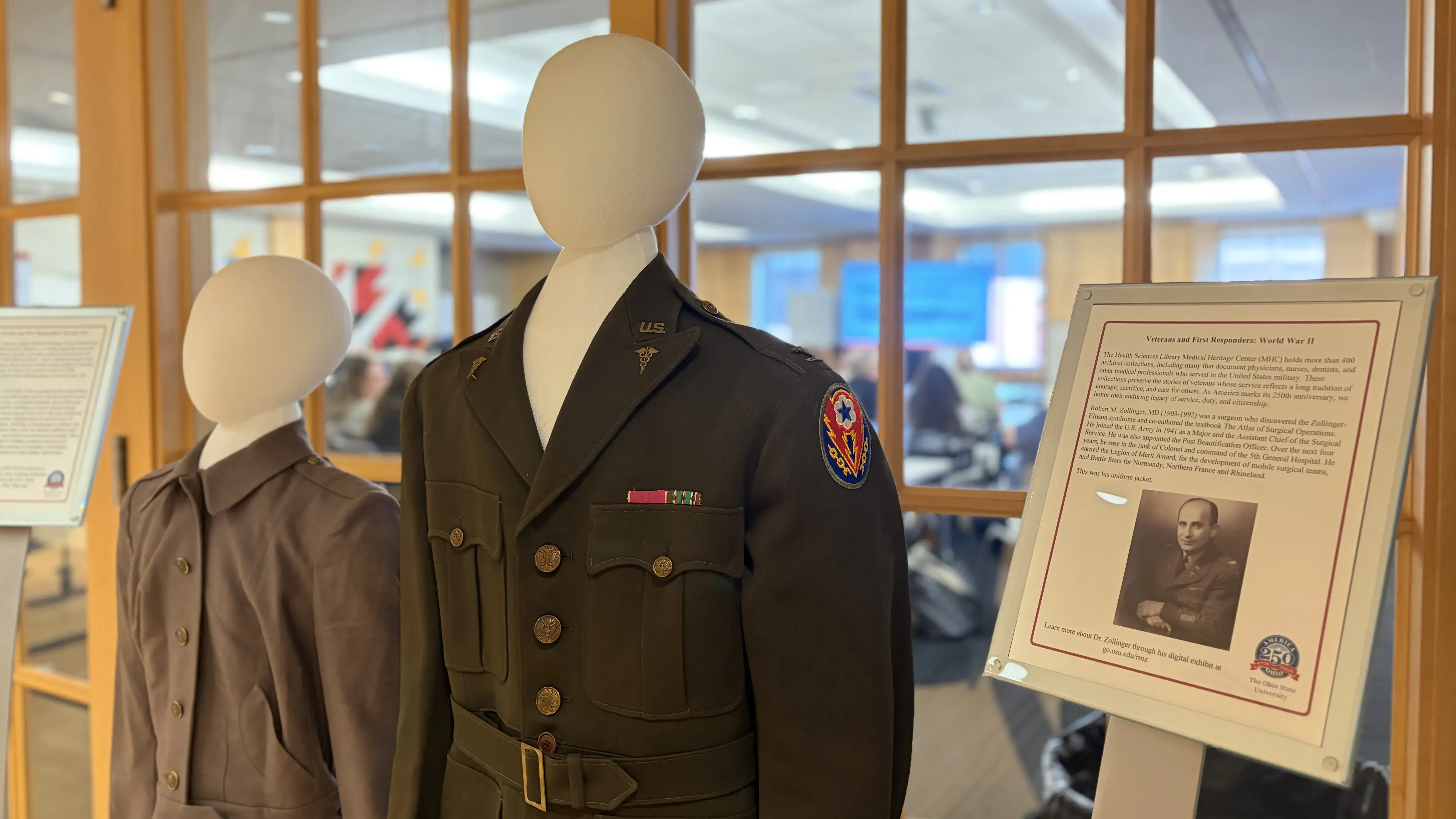
The Zollinger digital exhibit, “Robert M. Zollinger: Teacher, Surgeon, Soldier, Farmer,” is an insightful view into Zollinger’s incredible contributions to the discipline of medical surgery and was supported by The Robert M. Zollinger Legacy Endowment fund. An upcoming exhibit about the legacy of Arthur G. James, founder of The James Comprehensive Cancer Center (The James) at Ohio State and tireless advocate for cancer research, will be funded by The Arthur G. James, MD, Library fund (also held by The James).
As Judith says: “Donor funding empowers us to dream bigger and achieve more than we ever could alone, and we are deeply grateful for that continued support.”
Keeping the past relevant
The mission of the MHC is to “preserve, promote, teach and celebrate the healthcare legacy of central Ohio as the essential foundation from which the future of the health sciences is born.” The past is essential to understanding our future, and making historical collections accessible to as many people as possible contributes to the MHC’s mission.
As Judith observes, these digital exhibits are opportunities for students, scholars and members of the general public to connect with the MHC’s collections, whether for school projects, history fairs, scholarly research or personal exploration, and this sometimes leads to new curiosity: “The increased awareness generated by these projects has sparked interest and led to on-site visits by scholars, school groups and Ohio State classes, further strengthening our engagement efforts.”
Learn more
To browse the MHC’s “Stories from the Past” story map digital exhibits, visit our Digital Collections and Exhibits webpage.
To learn more about ways you can help support HSL collections and services, visit our Give to the Library webpage.
To schedule an on-site tour of the MHC, please send an email to MHCmail@osumc.edu.