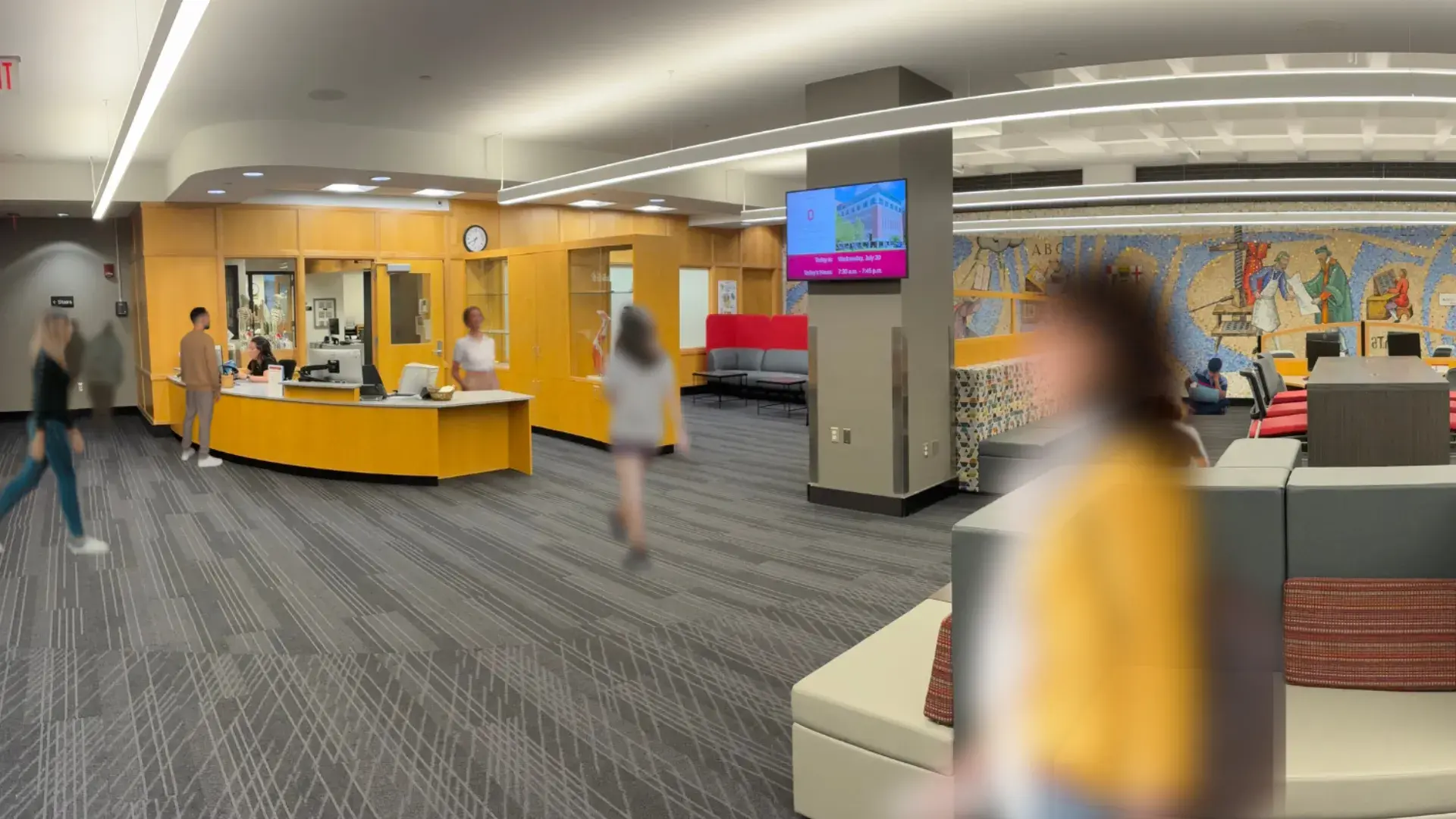
The Ohio State University Health Sciences Library (HSL) has always had ties to Ohio State’s Biomedical Sciences (BMS) program since it was first introduced as an undergraduate major in 2005. In 2006, former Health Sciences Library (HSL) faculty librarian, Carol Powell, began teaching a first-year required major course called, Mastering the Biomedical Literature I. The primary objective of the course was to teach and reinforce information literacy competencies as they relate to biomedical research. The course began as pass/fail and became a graded course in the early 2010s.
After Carol retired from Ohio State in 2014, Stephanie Schulte, then HSL research and education librarian and current HSL director, took over the role of course instructor in spring 2015 with a co-instructor. Stephanie was the sole course instructor from 2016 to 2024. Stephanie then co-instructed with Kaylie Vermillion, HSL research librarian, in 2025. Kaylie and Katie Blocksidge, head of HSL’s research and education department, began co-instructing the course in 2026.
The Challenge
Biomedical sciences (BMS) students are top-notch learners who are not used to struggling in an academic sense. Despite being high academic achievers, it’s common for first year BMS students to find reading full scientific articles and understanding what the articles are saying to be a challenge.
“Learning to ask good questions, identify gaps in knowledge within the literature and design experimental studies is the core of being a scientist,” says Stephanie. “It’s a level of thinking that [the students] have not been pushed to do much of prior to college.”
In addition, knowing how to perform scientific research via literature is vastly different from research in a lab. Reviewing scientific literature may not be as “exciting” as hands-on work in a lab, but it is still “crucial to the forward progress of scientific research discoveries,” Stephanie adds.
Finally, group work is a big part of the Biomedical Literature I course. Navigating role expectations within the groups and time-management for completing the group project are skills the students sometimes need to develop. “Many students – despite being warned – will wait until the week of an assignment to do the work, when this kind of work requires time to read, digest and understand in order to really do well,” Stephanie observes.
Our Approach
The Biomedical Literature I course helps fill the scientific literature review knowledge gap. And because the course was designed and has always been taught by HSL faculty librarians, it’s also an opportunity for students to shed any preconceived ideas about libraries and librarians and to learn how academic libraries can operate as teachers, research partners and service providers.
During the time Stephanie taught the course, she made significant changes to the curriculum while remaining true to the learning objectives set forth originally. Stephanie brought with her more than a decade of real-world experience in corporate science labs and as a science librarian. She incorporated this context into the course, in alignment with the information literacy competencies the students would need and could build on as they progressed through their degrees and careers.
One change Stephanie introduced was having each student group create their own hypothesis based on a knowledge gap, vs. allowing them to reuse a hypothesis they found in the literature. She also added more content about data management and scholarly publishing, since these are important pieces of a scientist’s work.
More recently, a section focused on artificial intelligence (AI) was added into the course. This section of the course has evolved from simply covering the basics of AI to using an AI tool to search for information about a specific topic, evaluating the output and then discussing the pros and cons of using the tool.
The Impact
The BMS course helps students build a crucial, solid foundation in the academic research world, including how to search and retrieve articles, evaluate knowledge gaps, learn about policies that might impact their work, create hypotheses and design studies.
The impact on BMS students is both deep and long-lasting:
- The course allows students to form long-term relationships with an Ohio State HSL librarian, a benefit to them throughout their undergraduate health sciences studies.
- Because non-medical faculty instruct this course, students have an opportunity to have meaningful interaction with faculty librarians who are deep in health sciences but are not medical clinicians.
- The course teaches transferable critical thinking skills to BMS students, most of whom go on to pursue professional and post-graduate degrees.
Scientific literature is an important part of being a science-focused researcher and for keeping up-to-date with new advances in medicine and the health sciences. “In a time when the information world is changing faster than ever, it is crucial that we build critical thinkers who are information literate,” Stephanie says. “They are our future scientists and clinicians.”